According to 7 Things You Should Know About Games and Learning, gamification refers to the dynamic games based on content of the courses that benefit future teaching and learning. The aims are to increase engagement, enhance learning and explore new models of education. Gamification means
In this article, “Just” Playing Games? A Look at the Use of Digital Games for Language Learning , the author discusses the application of digital games in language learning. Digital games can not only overcome difficulties like intercultural competence and pragmatics, but also modify the learning and teaching process and influence many aspects of language acquisition. It mainly focuses on the goal, interaction, feedback, context and motivation. When involving games into classroom, we as teachers need to always keep in mind the purposes like what language point I want my students to practice. Interaction is very important. We need to make sure that students are engaged into the games. Thus we need to make the games challenging while attractive. To increase interaction, we can also have students work in groups so that they can be more confident and more willing to put effort. Another important thing for successfully conducting the digital games in learning is feedback. The digital games are very good and effective at giving feedbacks. Thus the learners can be aware of their abilities.
Also in the video Tom Chatfield: 7 Ways Games Reward the Brain, the speaker also discusses some important aspects for successfully applying games into learning. The speaker mentions the importance of breaking learning process into pieces by establishing long and short-term aims. He also talks about how other people are important during this process. Since engagement is one thing that support learning and games are considered highly involved activities, learning through games definitely will improve learning compare to other traditional classroom activities.
Monday, March 16, 2015

Sunday, March 8, 2015
Learning or playing: It's your choice!
Many people view Twitter as a waste of time including me. This bias may result from the fact that most people use Twitter to follow celebrities and interesting stories. However after reading articles concerning this bias together with my personal experience of using Twitter, I found out that Twitter can be a very useful tool in education especially language teaching and learning process.
First of all, to effectively use Twitter as a knowledge resource, we should use hashtags to filter the information needed. For example, if you want to search for language learning, simply putting language learning as keywords with # in the front, you can view how other people learn language and what solutions to the problems that are commonly encountered by learners.

Second, we can join in Twitter chat to make realtime chatting with others. We can ask questions or give answers to other persons' questions. Twitter creates multi-media environment in which pictures, videos and links to other useful websites are mixed together.
Last, by following other people in a particular field, we can observe a long term development. Tweets by other people offer the perspectives of how they view this field. Thus we can see changes in this field or in this person by browsing his or her tweets in a period of time.
In my future teaching, I might use Twitter in classroom when I want to discuss a topic with my students. Seeing other people's opinions especially from all around the world can broaden their views and stimulate their creative and cognitive thinkings. One more thing about using Twitter in classroom that inspired me is the idea of creating a class account as a platform to include the ideas and feelings shared by the students. That works like a profile of the class which can record the development of the students. I will definitely try it in my future classroom.
First of all, to effectively use Twitter as a knowledge resource, we should use hashtags to filter the information needed. For example, if you want to search for language learning, simply putting language learning as keywords with # in the front, you can view how other people learn language and what solutions to the problems that are commonly encountered by learners.
Second, we can join in Twitter chat to make realtime chatting with others. We can ask questions or give answers to other persons' questions. Twitter creates multi-media environment in which pictures, videos and links to other useful websites are mixed together.
Last, by following other people in a particular field, we can observe a long term development. Tweets by other people offer the perspectives of how they view this field. Thus we can see changes in this field or in this person by browsing his or her tweets in a period of time.
In my future teaching, I might use Twitter in classroom when I want to discuss a topic with my students. Seeing other people's opinions especially from all around the world can broaden their views and stimulate their creative and cognitive thinkings. One more thing about using Twitter in classroom that inspired me is the idea of creating a class account as a platform to include the ideas and feelings shared by the students. That works like a profile of the class which can record the development of the students. I will definitely try it in my future classroom.
Wednesday, March 4, 2015
Twitterchat: An interesting Experience
This week I tried the twitter chat for the first time. I found it really interesting. Twitterchat is different from other communicative approaches that I had ever experienced. It is more open and more social. By using the hashtag, people who are interested in a same topic can discuss together.
I followed the #ntchat (new teacher chat) which discuss the importance and current place of social studies in the classroom. We mainly discussed four questions about the application of social studies. The questions are the following:


I replied those four questions with my own opinions.

I followed the #ntchat (new teacher chat) which discuss the importance and current place of social studies in the classroom. We mainly discussed four questions about the application of social studies. The questions are the following:
I replied those four questions with my own opinions.
During and after the chat, I realized how the social community provide resources that we can use in the future teaching. People would offer links to which they consider useful for this question or share personal experience about the certain topic. For example, some people suggested to use mysteryskype with the combination of textbook to better facilitate students with the understanding of social studies. I enjoyed this casual and informal way of communication.
Wednesday, February 25, 2015
Global Learning
Students are living in the global village thanks to the internet. In addition to knowing others lives and cultures, learning together globally is also another important advantage that we can take from this network. Being in a same environment, you may share the same learning style and perspectives on many issues. However, seeing how people from other countries and cultures work on certain problems can broaden your horizon and make you more creative and critical on problem solving.
There are many websites that provides the platforms allowing students around the world to communicate to each other. Today I want to share my experience using one of them - ePals.

It provides many programs and activities concerning many topics within which students from around the world can share their own opinions, solutions and suggestions.


There are many websites that provides the platforms allowing students around the world to communicate to each other. Today I want to share my experience using one of them - ePals.
It provides many programs and activities concerning many topics within which students from around the world can share their own opinions, solutions and suggestions.
Take the first activities as an example.
It encourages the students to share stories about protecting the environment and improving the world. Once a student submits a piece of work, they will turn the country on the map where the student comes from into green.
I just like the way it motivate the students. Besides, students can choose between individual activities and group activities which get the students more involved as a group. They can build up a team across countries.
In my future teaching, I really want to introduce this website to my students. This is a place that can really have the students experience the importance and pleasure of global communication. Thus can motivate them to learn more about the language itself. With the better language ability, students may have more possibility to learn from others all around the world. Moreover, if I want to have my students work on a program and help them to compare their works with other students from other countries, I may even create that program by myself. It really is a great place to learn and communicate globally.
Broaden your community
With the fast development of technology, learning has been changed from interpersonal into interpersonal. What resources you can have is more important than what knowledge you can possess at a certain point. Building up a broader community certainly will help you keep up with the rapid changes happened everyday.
However some people may be intimidated by the new technological tools. There is a video Alan Levine-New Media Consortium which introduces how we can deal with the technology. The man Alan Levine first points out the importance of building up the community by establishing the network of colleagues in or beyond one field. Then he suggests that in order to make the first step and experience the advantage of technology, people should be more brave and be willing to try new things. Sometimes it might be even necessary to push ourselves out of the comfort zone and put aside things that we are very familiar with. With the courage of experiment, one can definitely figure out the advantages of networking.
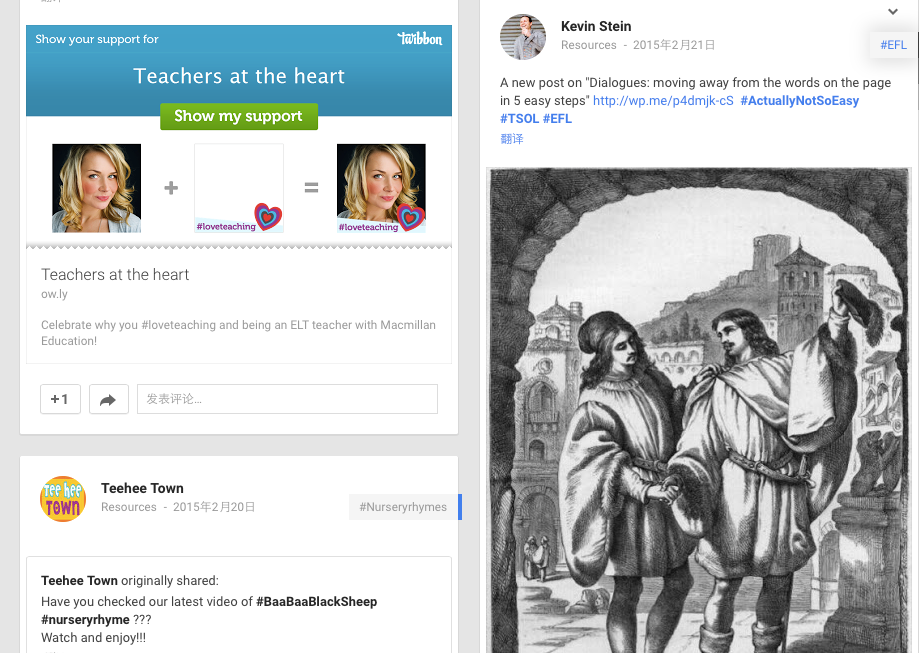
I also tried to join in the English Language Teaching community - one of the Google+ communities. The best thing I like about the community is that it allows you to browse a huge amount of information in a very short time. I can choose whatever catches my eyes first and go deeper to figure out more information about it. Thus can save time and offer the chance to get access to things that I may never get a way to know.
However some people may be intimidated by the new technological tools. There is a video Alan Levine-New Media Consortium which introduces how we can deal with the technology. The man Alan Levine first points out the importance of building up the community by establishing the network of colleagues in or beyond one field. Then he suggests that in order to make the first step and experience the advantage of technology, people should be more brave and be willing to try new things. Sometimes it might be even necessary to push ourselves out of the comfort zone and put aside things that we are very familiar with. With the courage of experiment, one can definitely figure out the advantages of networking.
I also tried to join in the English Language Teaching community - one of the Google+ communities. The best thing I like about the community is that it allows you to browse a huge amount of information in a very short time. I can choose whatever catches my eyes first and go deeper to figure out more information about it. Thus can save time and offer the chance to get access to things that I may never get a way to know.
Tuesday, February 24, 2015
Which is more important: How or What?
A learner is like a node in a railway system. A complete and integrated railway system makes a well connected country. With the railway system, the country as well as the people become a whole. People can go any places by trains quickly as long as they are inside the system.

This point is also raised in the video The network is the learning. The concept is that the way we are connected to other individuals is largely responsible for our ability to continue to stay current in the field. Actually we have already use network to daily life such as keeping connected with families and friends. But how we can adopt this concept into learning is the main problem that needed to be paid more attention to. By building up a network, learners can get access to knowledge concerning to other fields easily. One point from the video that I like the best is that what we know today is not as important as our ability to continue to stay current. Because the knowledge change rapidly, we can not expect that what we have learnt can last forever. So how to learn is more helpful than what is learnt.
Chinese Railway System
As for the learners in technological age, it is more important to build a network within which multiple kinds of information can be shared rather than just learning the knowledge it self. Just as it is said in the article Connectivism:
A Learning Theory for the Digital Age, A network can
simply be defined as connections between entities. Computer networks, power
grids, and social networks all function on the simple principle that people,
groups, systems, nodes, entities can be connected to create an integrated
whole. In this article, it introduced the concept of connectivism, which refers to the integration of multiple principles including network and other theories. There is one point, Learning is a process of connecting specialized nodes or information sources that I strongly agree with. Nowadays, learning is not only happened inside one person. Sharing information makes the learning process more effective and integrated. When we as learners connecting with another node, more information resources would be poured into our own knowledge database and the system will be more integrated as a whole.This point is also raised in the video The network is the learning. The concept is that the way we are connected to other individuals is largely responsible for our ability to continue to stay current in the field. Actually we have already use network to daily life such as keeping connected with families and friends. But how we can adopt this concept into learning is the main problem that needed to be paid more attention to. By building up a network, learners can get access to knowledge concerning to other fields easily. One point from the video that I like the best is that what we know today is not as important as our ability to continue to stay current. Because the knowledge change rapidly, we can not expect that what we have learnt can last forever. So how to learn is more helpful than what is learnt.
Thursday, February 19, 2015
DIIGO vs Pinterest: Two useful websites for language learning
DIIGO is a website famous for it's function of social bookmarking. It allows users to keep track of their favorite websites by tagging which is an efficient function. By searching tags, we can narrow down to a smaller scale to find the websites we want to look for.

Tag List

My Library
Besides, it's more useful than traditional bookmark on the browser since it allows users to access their favorite websites from any computer.

Pinterest is a website that offers a visual collection, sharing and storage tool. Boards can be created with items, images and videos being pinned to them.
I want to compare these two websites through the following questions:
Questions
|
DIIGO
|
Pinterest
|
Can you highlight text in saved sites?
|
√
|
×
|
Can you use multiple tags?
|
√
|
√
|
Can you copy and paste from original article to appear in
comments about site?
|
× |
√
|
Can others post comments on your site?
|
× |
√
|
Can you follow others? Can they follow you?
|
√
|
√
|
Can you message people you follow?
|
√
|
× |
Are you offered suggestions for related articles?
|
√
|
|
Would you continue to use either of these?
Which? Why?
|
Yes! I like the way it creates a network. When I see other people's home pages, it's clearly presented what they have in the libraries. I can benefit others
within my community and vice versa.
|
Yes! I like the visual collection of images and videos
since it’s more direct and impressive than words.
|
Both websites provide the tagging function. For DIIGO, I do find this network useful since I can find what others like and learn from them just by searching their libraries. For Pinterest, I learnt a lot from it such as interesting classroom activities and new ideas about teaching. I feel like in this fast pace world, pictures are more favored by people than words since it's more direct and provide more evidence. Besides, images can offer the real situation rather than imagination from only word description. I find the Pinterest more like a social network like Instagram. However, it's more suitable for learning and sharing information as it provides links to the original resources. In addition, it separates the information by different topics. Thus allows the users to find more related information within one category.
Hope you find these tools useful and interesting. If you have experience of using any of them or other websites you think are useful, share with me!
Hope you find these tools useful and interesting. If you have experience of using any of them or other websites you think are useful, share with me!
Subscribe to:
Comments (Atom)